Sales & InvoicingFrom quotation to cash, without typing anything twice.Show details
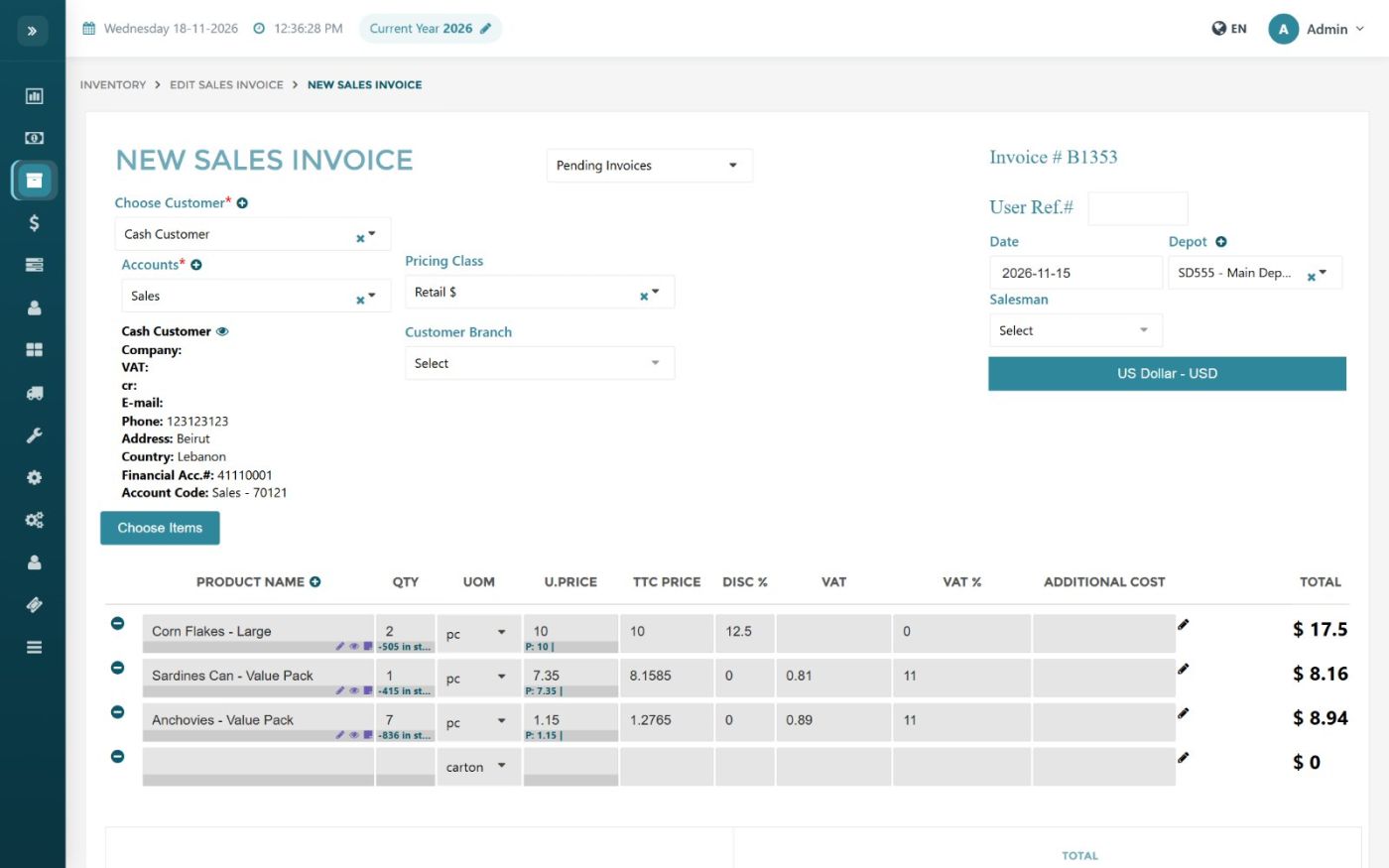
Create quotations, turn them into orders, deliver with a delivery note and invoice in one click. Every invoice keeps its own currency and exchange rate, VAT, salesman and payment terms, and updates stock, the customer balance and accounting at once.
Documents flow
Quotations with revisions: Send a quotation, revise it, keep the history.
One-click conversion: Quotation to order to delivery note to invoice. The system refuses converting the same document twice.
Sales orders: Follow open orders; turn a sales order into purchase orders per supplier.
Delivery notes: Deliver now and invoice later, including partial deliveries.
Your own document series: Named and separately numbered invoice types.
Invoices
Sales invoice: Cash, cheque, card or credit; split payments; due date; VAT and second VAT; item and invoice discounts.
Currency and rate on every invoice: Each invoice keeps its currency and exchange rate, with the total also shown in the second currency.
Salesman and commission: Each invoice carries the salesman; commission is calculated on sales minus returns.
Customer branch, driver and vehicle: Deliver to the right branch of the customer and track the driver.
Due date list: Invoices by due date to plan collections.
Consumption: Take goods out at cost for a customer or internal use, without a sale.
Data collector: Files from handheld scanners become sales invoices.
Returns and exchanges
Customer returns: The server refuses returning more than was sold.
Financial return (no quantity): A credit without moving stock.
Exchange: Return and re-sell in one step with balanced entries.
Delivery and online orders
Shipping companies: Courier companies with fees and accounts; track shipments and cash collected by the courier.
Store orders board: Orders from your customer app: confirm, prepare, deliver and turn into an invoice.
Purchasing & ImportsBuy smart, know the true cost of every item.Show details
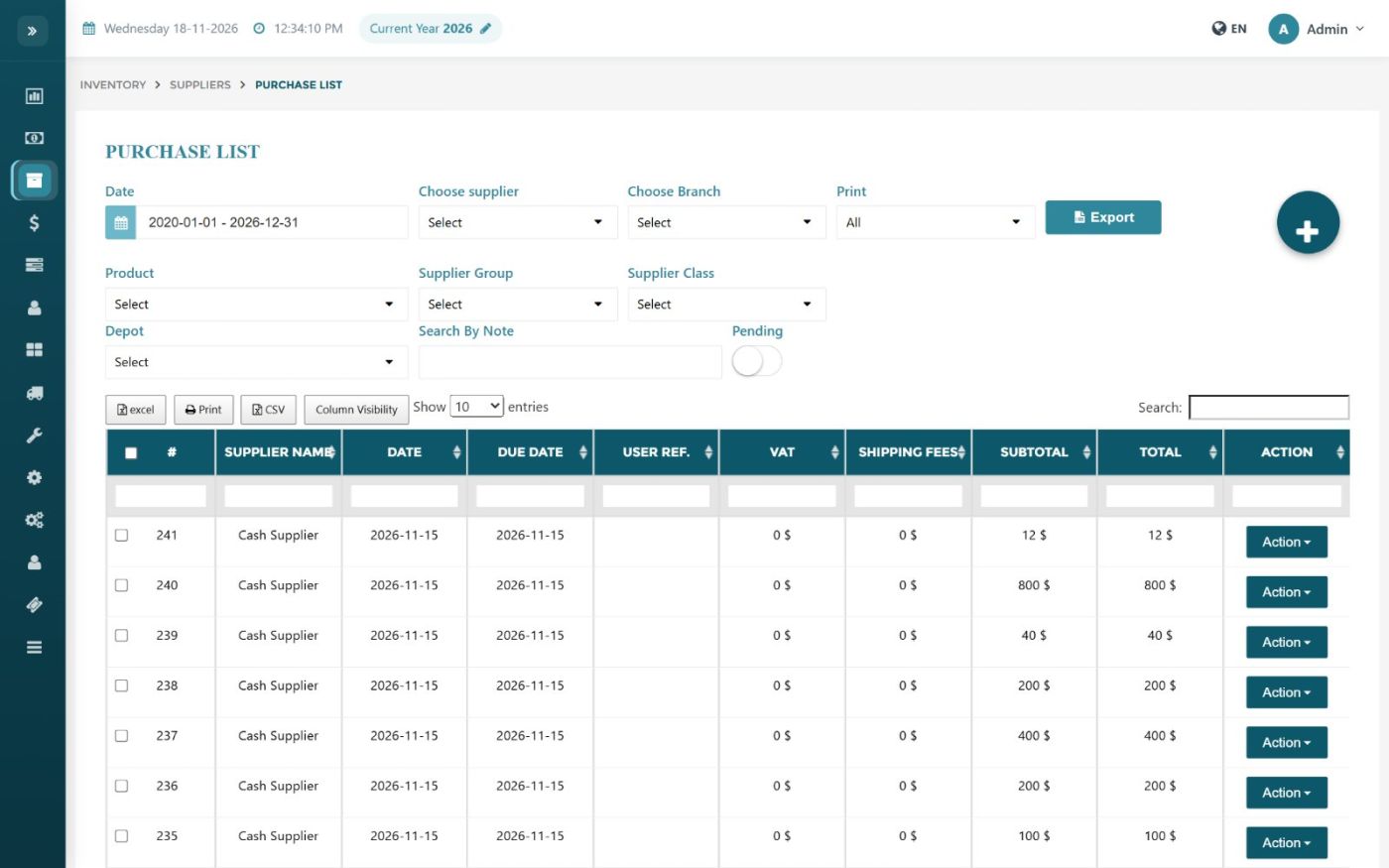
Purchase quotations, orders, goods received notes and supplier invoices, connected to stock and accounting. For importers, freight, customs and other costs are spread on the items so the cost price is the real landed cost.
Purchase flow
Purchase quotations and orders: Ask suppliers for prices, then order; the order becomes the invoice.
Purchase delivery note: Receive goods before the invoice arrives, then convert.
Supplier invoice: Depot, unit, lot, serial and expiry per line, with VAT.
Due dates: Supplier invoices by due date to plan payments.
Supplier returns: Return goods; the server refuses returning more than was bought.
Imports and landed cost
Landed cost: Freight, customs and other costs are spread on the items by the method you choose.
Customs and clearing details: Clearing agent, IDF / CEPS / CCVR numbers and container deposit on the delivery note.
Import details: Container, CTN and FOB per purchase.
Supplier pricing
Supplier price lists: Purchase prices per supplier, in their currency.
Supplier discounts: Discounts per item as a percentage or an amount.
Supplier product codes: Keep each supplier's own code for your item.
Financial purchase (no quantity): Book a purchase in accounting without moving stock.
Inventory & WarehousesKnow exactly what you have, where it is and what it is worth.Show details
Multiple warehouses and branches, transfers with request and confirmation, stock counts, damage and expiry tracking, and stock valued with FIFO, LIFO or average cost. Every movement has a trace on the stock card.
Warehouses
Multiple warehouses: Each with its branch, storage type and person in charge.
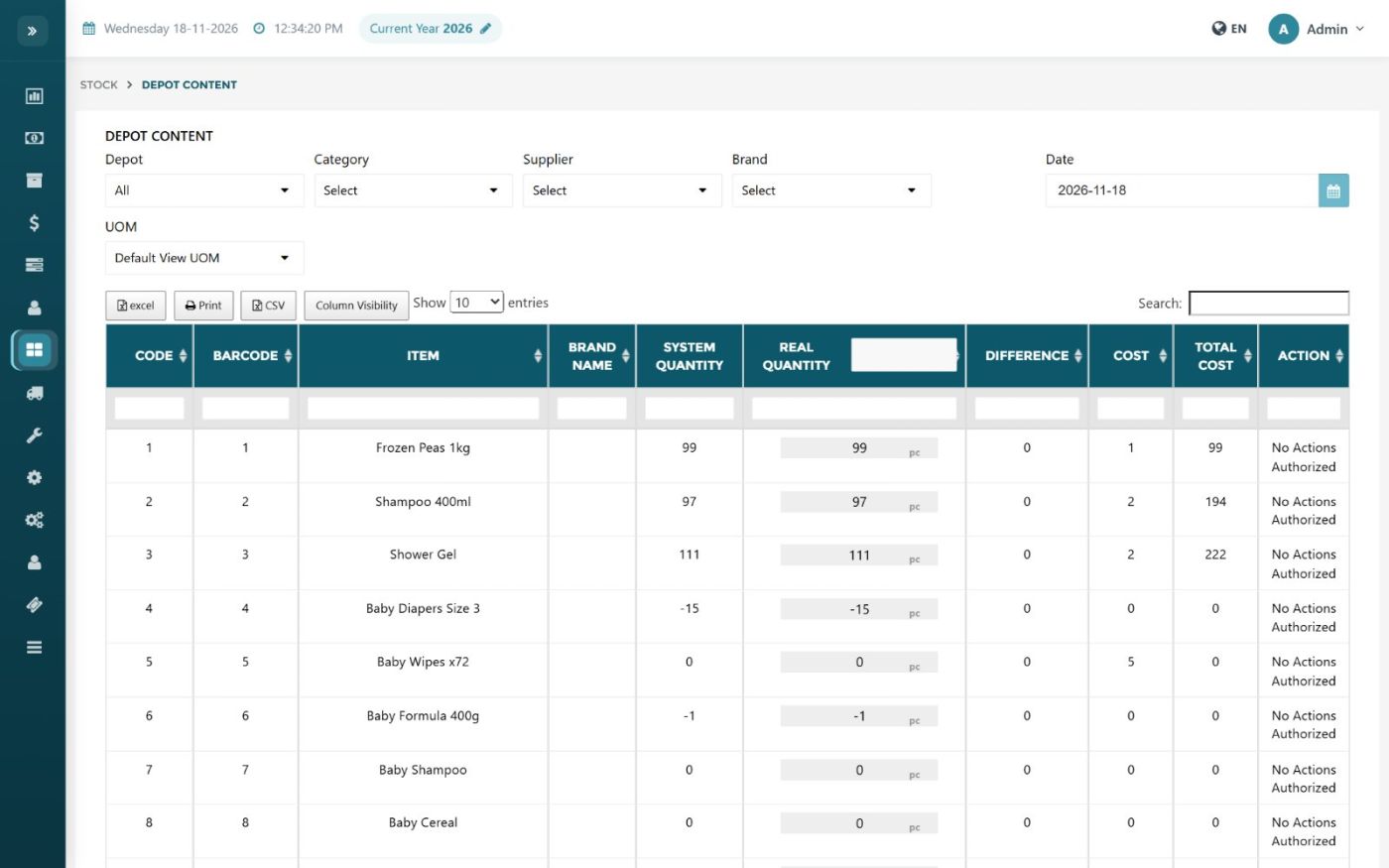
Warehouse content: Live stock per warehouse: system quantity against counted quantity, with adjust, damage and expiry actions.
Product locations and shelves: Where each product is stored.
Opening stock: Load opening quantities with cost, currency, lot, serial and expiry; import from Excel.
Movements
Transfer requests: A branch requests goods; the request is confirmed or rejected, then transferred.
Transfers with receiving confirmation: The receiving side confirms what really arrived.
Negative-stock control: Block transfers or sales that would make stock negative.
Damage: Record damaged goods with a reason, lot and expiry.
Counts and adjustments
Stock count: System against real quantity; the difference is posted.
Adjustment with accounting: An adjustment that also posts a journal entry to the accounts you choose.
Handheld counts: Counts from data collectors are uploaded as adjustment files.
Reorder list: Items under their reorder point, with the supplier.
Stock reports
Stock card: Every in and out with the running balance and cost.
Stock value: Stock value by warehouse at cost, last cost, FIFO/LIFO/average or any price list.
Backdated stock: Stock as it was on any past date.
Expiry, lot and serial reports: Items close to expiry and the history of each lot or serial.
Customers & Sales TeamSell more, collect faster, and know who owes what.Show details
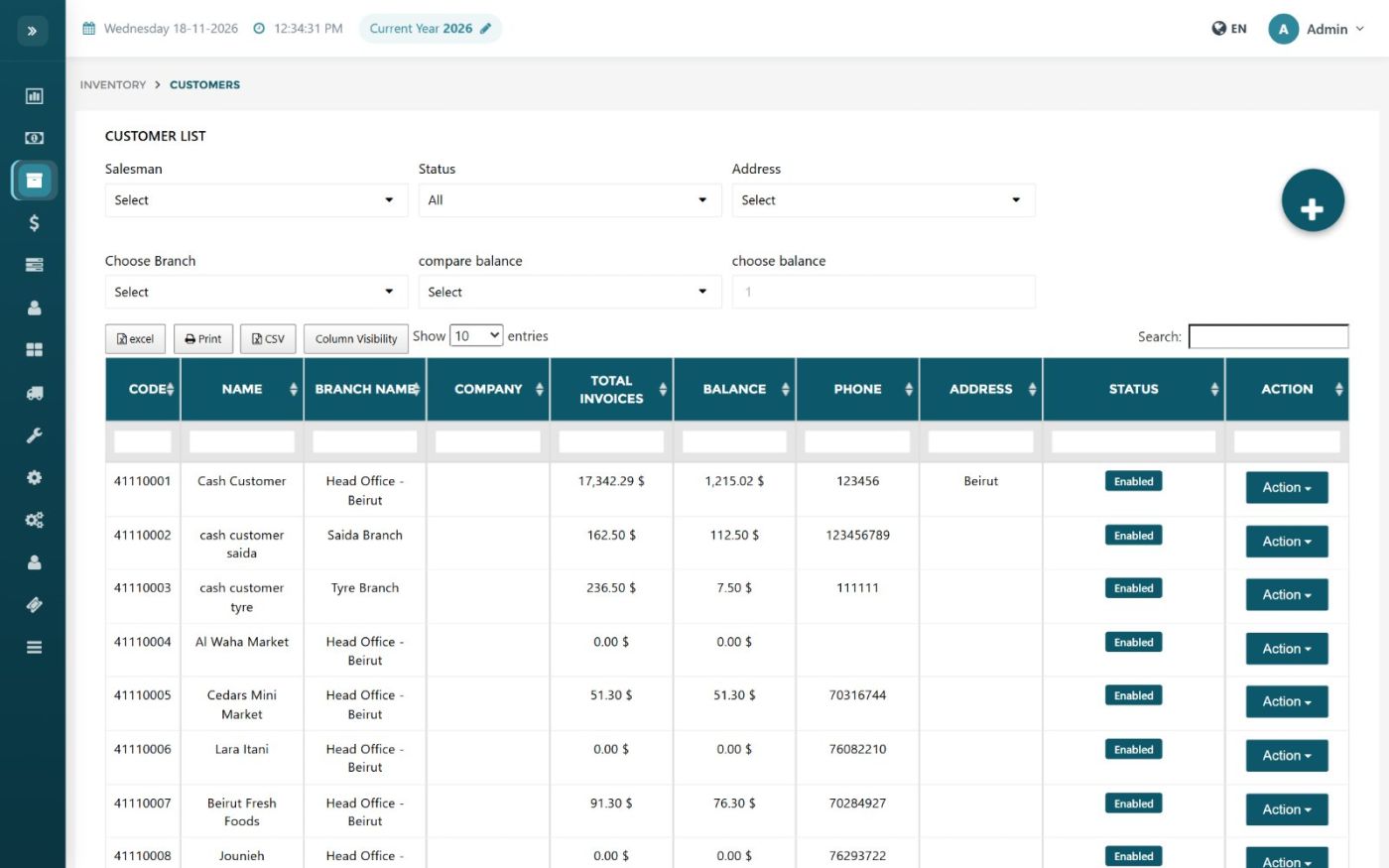
Customer and supplier files with credit limits, statements and aging, plus tools for the sales team: salesman per customer, routes and visits, commissions and performance reports. Connected to the sales-rep mobile app.
Customers and suppliers
Customer and supplier files: Contacts, groups, classes and regions; a customer can also be a supplier.
Credit limits: Balance against limit, with stopped customers flagged.
Statements and aging: Account statement and aging by period, current or on a date.
Customer product codes and allowed items: Keep the customer's own codes; limit which items a customer can buy.
Contracts and certificates: Customer contracts with dates, products and attached files.
Excel import: Load customers and suppliers from a file.
Sales team
Salesman per customer: Assign customers to sales reps.
Routes and visits: Route list, customers on each route, schedules and visit reports.
Commission: Commission per salesman on invoices minus returns.
Sales rep reports: Sales by rep, daily activity, distribution by customer, monthly and year-over-year graphs.
Accounting & FinanceClean books in dollars and lira, closed on time.Show details
Full double-entry accounting connected to every sale, purchase, payment and payslip. Lebanese chart of accounts, multi-currency with the rate saved on each entry, cheques, VAT closing, year closing and financial statements, with locked periods so the past cannot be changed.
Set-up
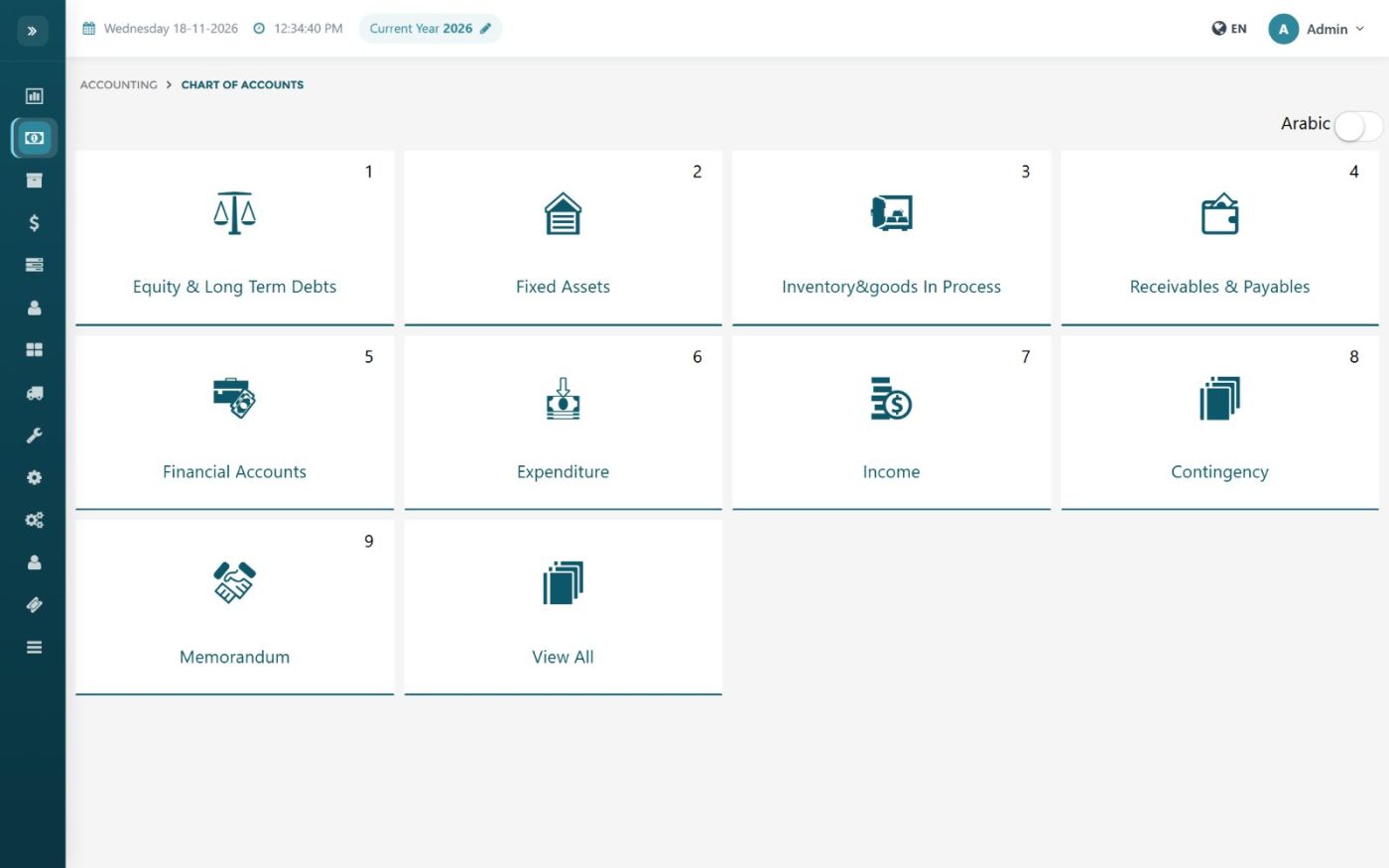
Chart of accounts: A standard Lebanese chart (English and Arabic names) copied into your company chart.
Currencies and rates: Local, second and third currency; rates typed as "1 USD = 89,500 LBP"; each document keeps the rate of its date.
Branches, cost centres and years: Every entry carries its branch and financial year; jobs act as cost centres.
Bank and cash accounts: Bank accounts and a cash account per drawer or user.
Daily work
Payments and receipts: In any currency, by cash, cheque or card, linked to invoices.
Cheques: Post-dated cheques by due date; collect or return; the server refuses a cheque collected twice.
Expenses with approval: Normal and cash expenses; pending expenses post only after approval.
Journal vouchers: Manual entries that must balance; opening balances.
Deposits and withdrawals: Cash to bank and currency exchange with a check that both sides match.
Credit and debit notes: Adjust a customer or supplier balance without an invoice.
Instalments: Split a bill into dated instalments and follow them.
Prepaid and accrued: Prepaid expenses and income, accruals; monthly entries post automatically.
Fixed assets: Assets register with automatic depreciation.
Closing and control
VAT closing: Clear VAT input and output into a closing entry for the period.
Year closing: Close the year and carry balances forward.
Lock data: Freeze everything up to a date: nothing back-dated can be added, changed or deleted.
Statements and reports
General ledger: Per account, per customer/supplier, or several accounts together.
Trial balance: With opening, movement and closing balances.
Income statement and balance sheet: In the currency you choose, for any period and branch.
Aging, VAT and top customers/suppliers: Ready reports for collections, VAT and analysis.
Custom report builder: Build your own report from account blocks and document types and add it to the menu.
Reports & AnalyticsThe numbers behind every decision, ready when you need them.Show details
More than ninety ready reports across sales, stock, purchasing, customers, accounting and HR, with filters by date, branch, category, brand, salesman and customer. Export to Excel, CSV or PDF, or build your own report.
Sales and profit
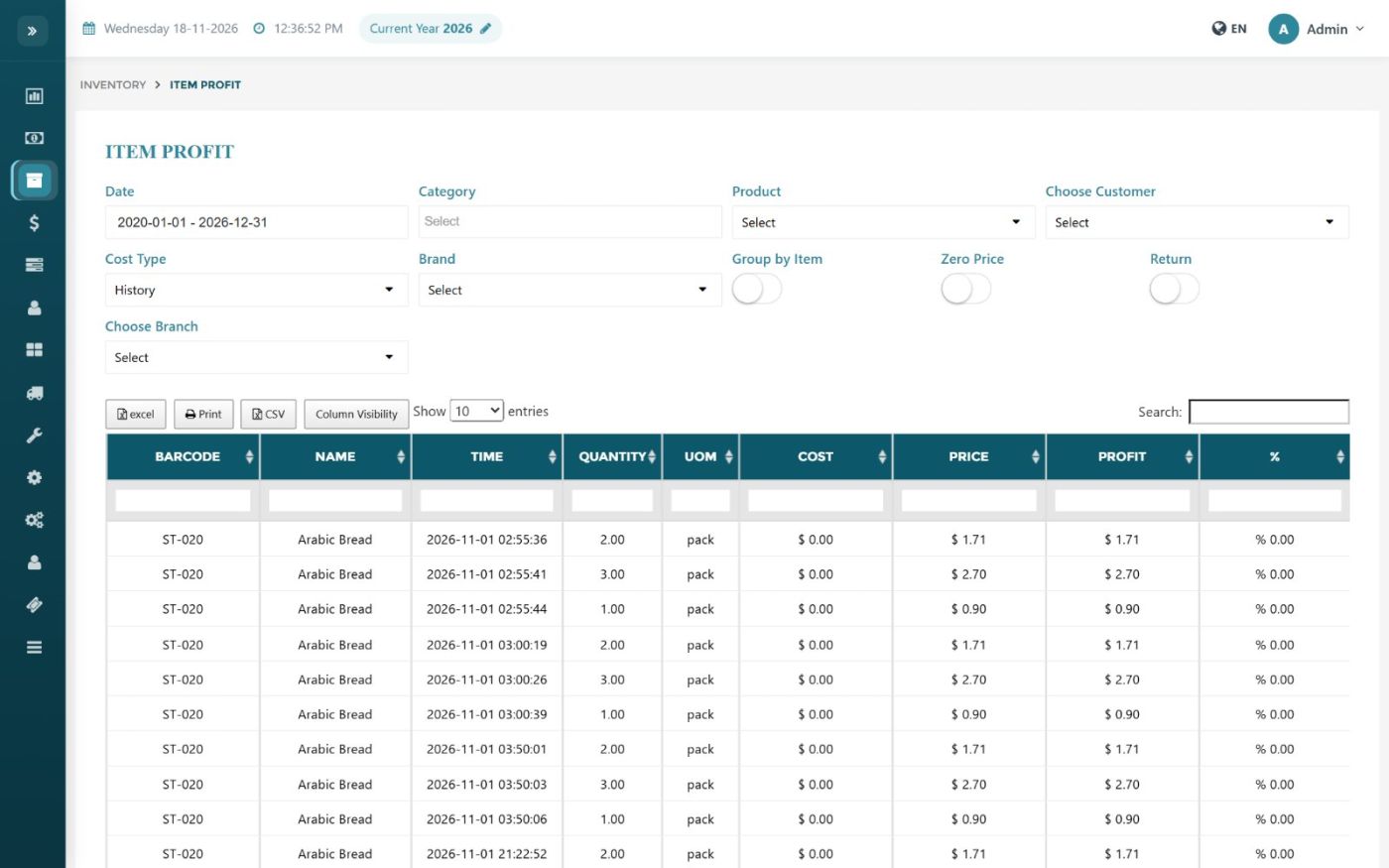
Item profit: Profit per item by history, average or last cost.
Sold items by brand, category and date: What sells, where and when.
Monthly and year-over-year sales: Graphs and lists by total and by product.
Sales by user and by salesman: Who sold what, every day.
Discounts and returns: Invoice discounts, returned and damaged items.
Stock and purchasing
Unmoved items: Slow movers that tie up cash.
Forecast: Sold quantity against stock and pending orders, by supplier, to plan purchases.
Movement per item: Every movement with quantities and values.
Expiry, lot and serial: Items to sell first.
Cash and shifts
End of shift and end of day: Cash per currency and per cashier.
Cash drawer log: Every drawer opening.
Your own reports
Report builder: Choose account blocks and document types; save the report to the menu.